Activate Retail in Your Coffee Shop
A retail coffee shop sells physical products alongside coffee. Learn how consignment lets you add retail with zero inventory risk, automatic split payouts, and no extra POS.
A retail coffee shop is a café that sells physical products alongside its drinks and food, turning browsing customers into buyers without requiring a separate store. If you run a café and want to add a revenue stream without buying inventory upfront, consignment is the most practical path: a maker places their products in your space, customers buy them, and you keep a share of each sale automatically. You carry no stock risk, and the maker handles restocking.
The model works because foot traffic and dwell time already exist in your space. Customers who wait for an espresso or linger over a flat white have time to notice, handle, and buy a well-placed product. You do not need a dedicated retail floor to make coffee shop retail work. You need one shelf, the right products, and a system that handles the transaction and payout without adding work to your team's day. SideStore's Retail Widget is built for exactly that. Before you invest in signage or sourcing, it is worth understanding the full opportunity to make money from unused shelf space.
Why Retail Works in a Coffee Shop
Retail fits naturally into a coffee shop because foot traffic plus dwell time creates a passive browse opportunity that most product categories can only dream about. Your customers are already there, already relaxed, and already in a spending mindset. A product displayed near the collection point or till needs no salesperson.
The economics are straightforward. A café's core margin sits on drinks, which carry strong per-cup returns but depend entirely on volume and throughput. Retail adds a parallel revenue stream that does not require an extra staff member, a larger kitchen, or faster service. Even a handful of product sales per week at a modest price point adds meaningful margin over a month, particularly if the products cost you nothing upfront.
Two models exist. The first is bought inventory: you purchase products wholesale, mark them up, and absorb the risk if they do not sell. That approach ties up cash and leaves you with dead stock when a product line fails to connect with your customers. The second is consignment: a maker places products in your café, you display them, and you receive a percentage of each sale with nothing owed if the product sits unsold.
For most café operators, bought inventory is the wrong starting point. Understanding how much profit does a coffee shop make on its core business reveals how thin the margin cushion is before taking on additional risk. Consignment preserves that cushion because your downside is exactly zero. You can explore more on coffee shop profit margins and the levers that move them, as well as what realistically affects profit from a coffee shop when you layer in additional revenue lines.
The practical conclusion: start with consignment, learn which product categories your specific customers respond to, and only consider buying inventory once you have real sales data behind you.
What Products to Sell in a Retail Coffee Shop
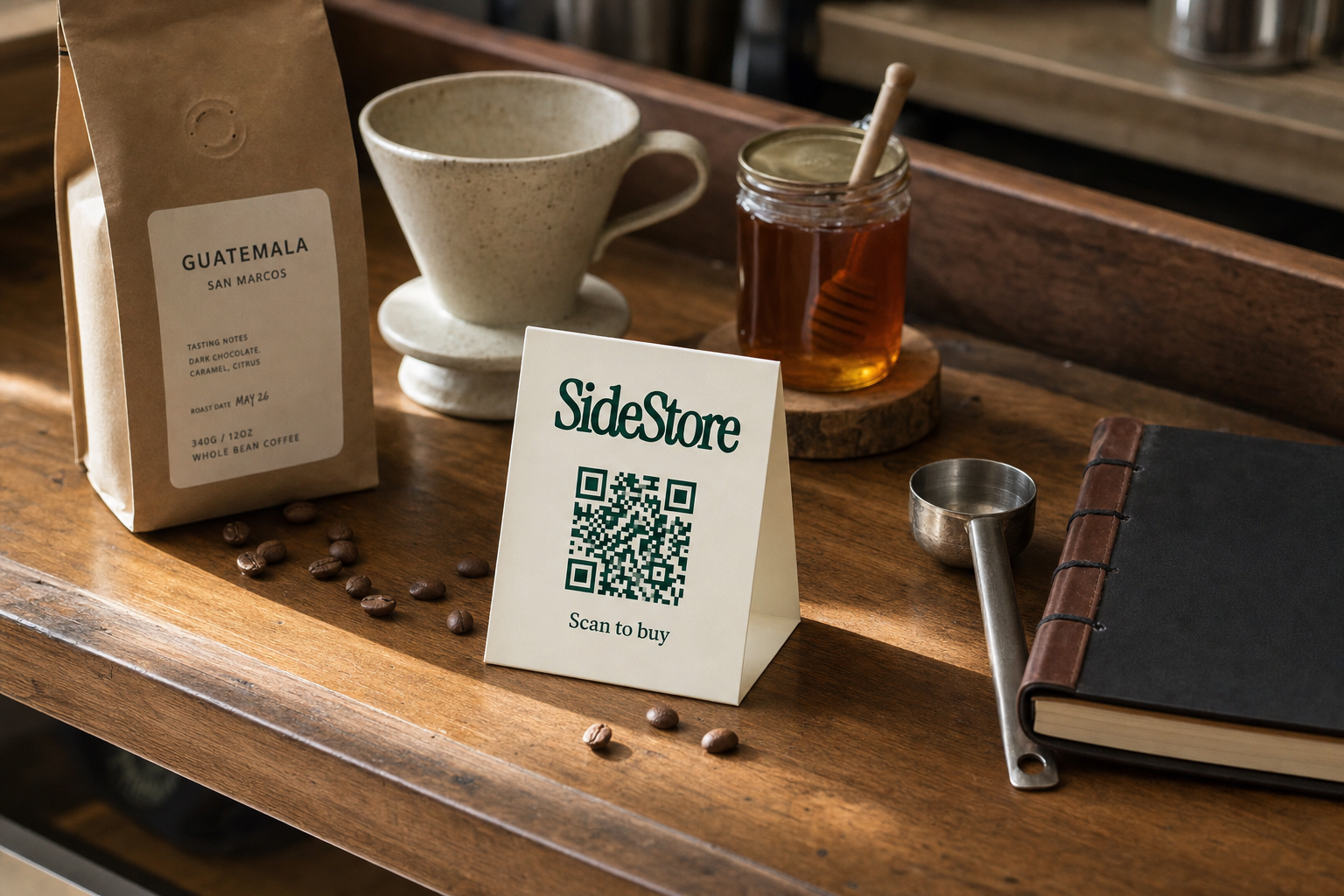
The products that sell best in a café are the ones that match your café's existing identity. If your space is warm, artisan, and independent, small-batch candles, handmade ceramics, and locally printed goods will feel at home. If your café skews minimal and modern, design-led stationery or specialty food products make more sense. Customers buy what fits the room they are already comfortable in.
Three categories consistently perform well across café settings.
Locally made food and drink products. Single-origin hot sauces, small-batch jams, specialty teas, or hand-roasted coffee from a different region than your own blend. These are adjacent to what you already sell and carry immediate credibility on your shelves.
Handmade lifestyle objects. Ceramics, candles, botanical prints, or textile accessories at a price point between ten and fifty dollars. That range sits comfortably within an impulse-buy decision for a customer who is already spending on a specialty coffee.
Branded or local creative goods. Zines, greeting cards, art prints, or small publications from local makers. These carry very low weight, need minimal shelf space, and have a natural fit with the independent café aesthetic.
Price point matters more than category. A product priced under twenty dollars sells itself passively. A product priced over eighty dollars usually needs a conversation, context, or a dedicated display. In a café, you rarely have staff bandwidth for either of those. Keep your retail range anchored to the impulse tier.
Sourcing through consignment solves the inventory problem cleanly. Instead of buying a range and hoping it moves, you invite makers to place their products in your space. If you want to understand the mechanics from the maker's side, the articles on selling on consignment and what consignment means give useful context when you are negotiating terms with a local maker for the first time.
How Consignment Works in a Café Setting
Consignment is an arrangement where a maker places products in your café and only gets paid when those products sell, leaving you with no upfront cost and no stock risk. The mechanic is simple, but it is worth walking through each step so you know exactly what you are agreeing to before your first maker drops off a box.
Step 1: Agree the placement terms. You and the maker agree which products, how many units, where they will be displayed, and what percentage split applies to each sale. A common starting range is sixty to seventy percent to the maker and thirty to forty percent to the host café, though this varies by product margin and category.
Step 2: The maker delivers stock. The maker brings a set number of units to your café. You display them. Nothing has been bought or sold yet. Your financial exposure at this point is zero.
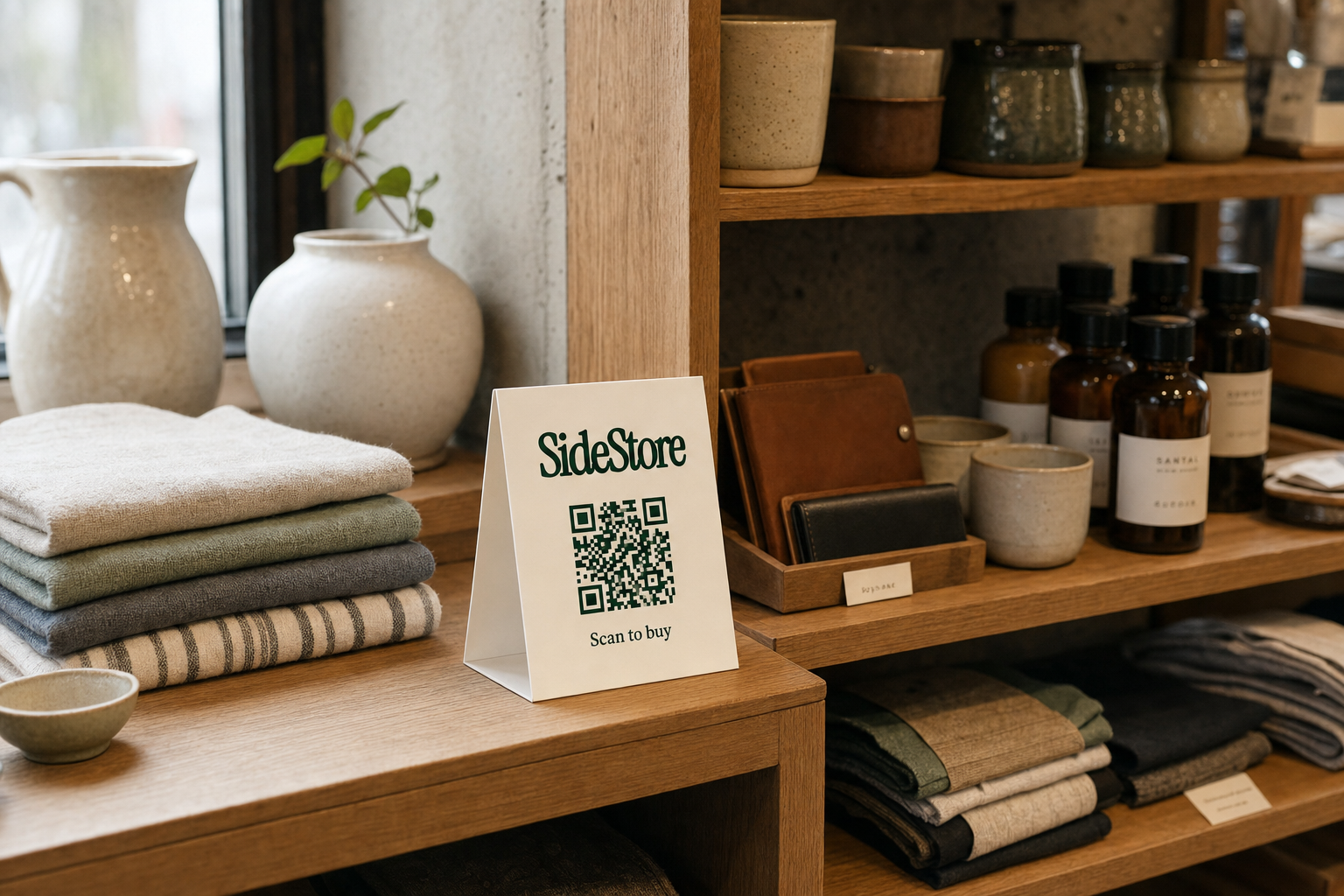
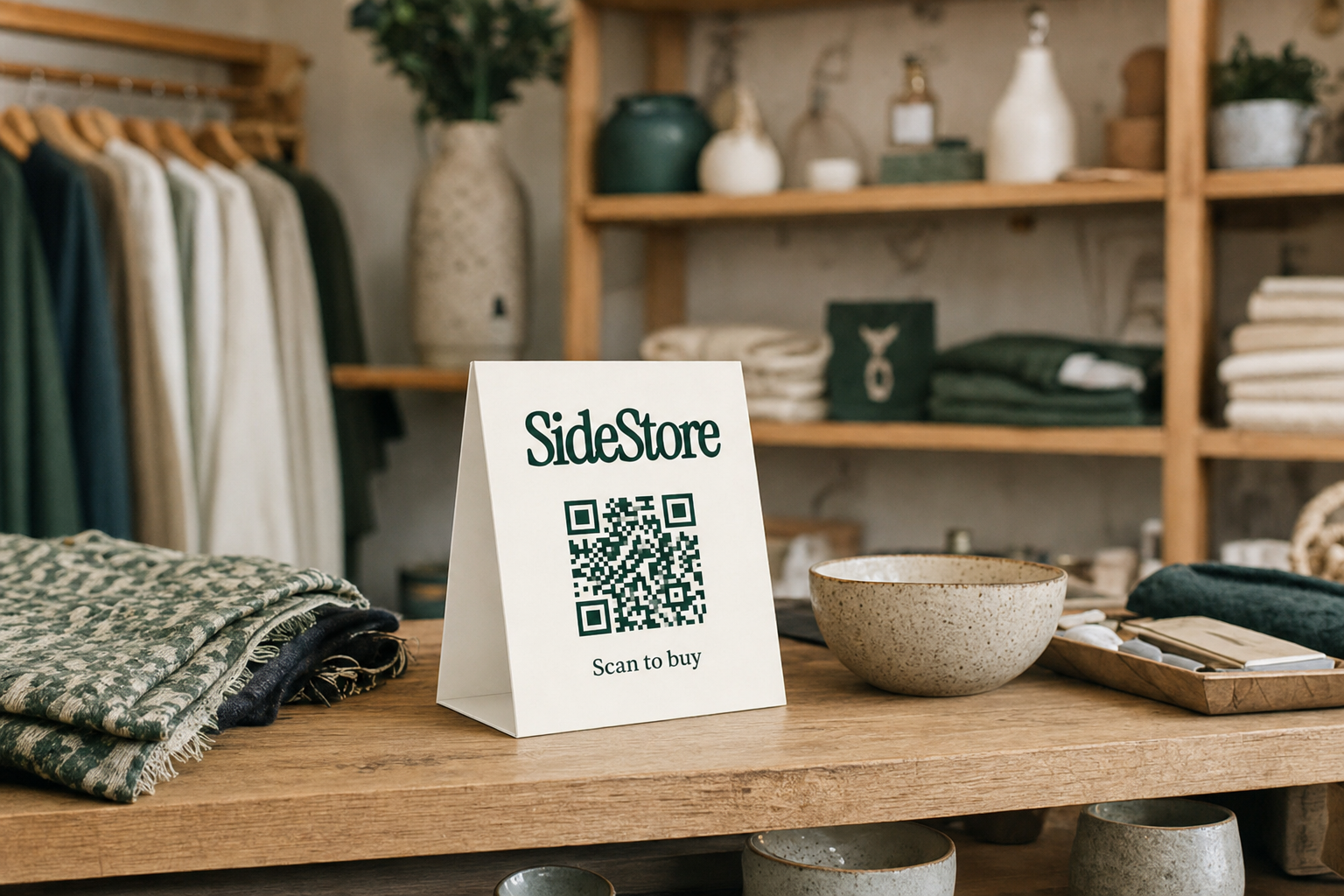
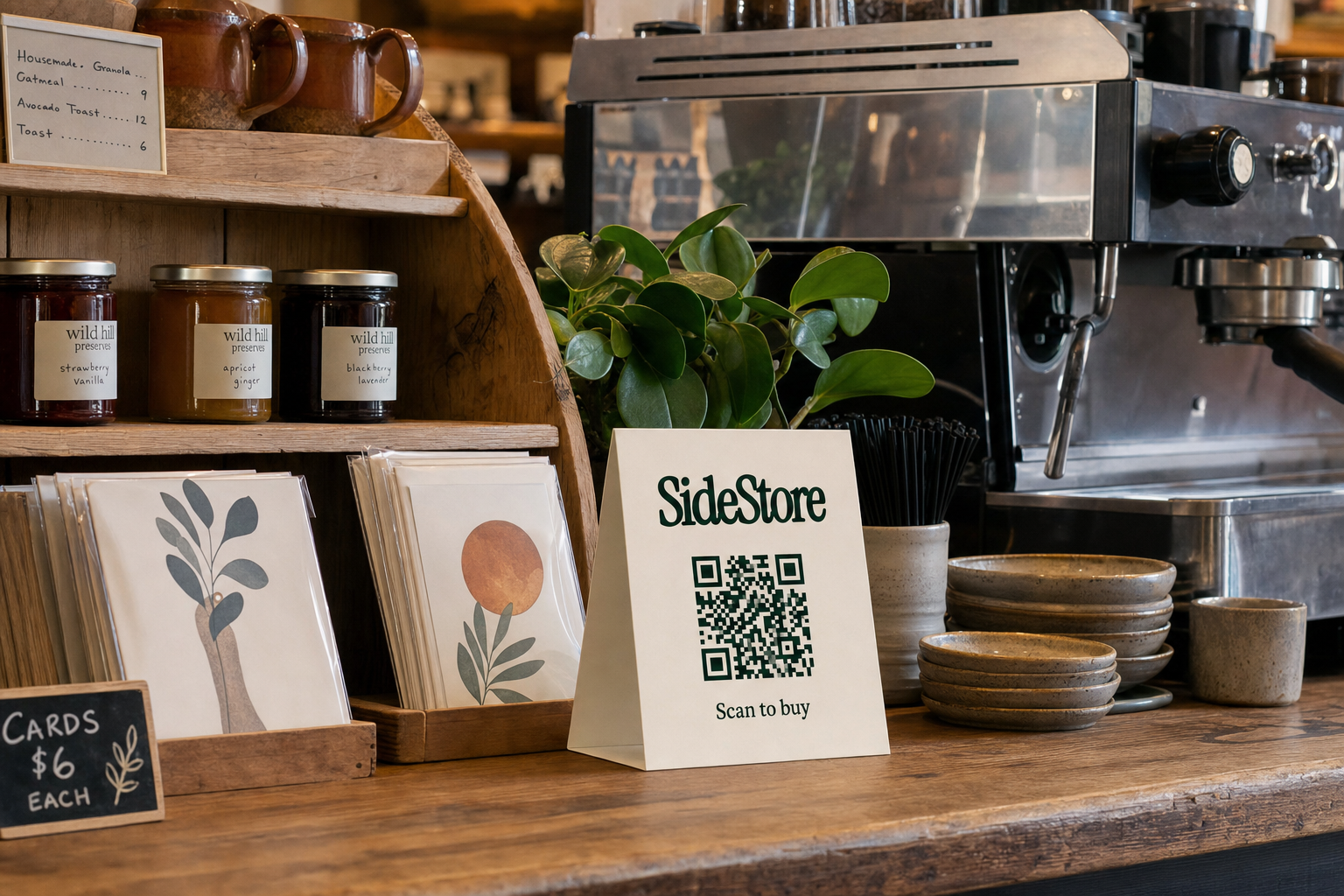
Step 3: A customer scans and buys. SideStore's Retail Widget handles the checkout. A printable QR card, one function of the Retail Widget, can be attached to the product or displayed alongside your SideStore placement. A customer scans it, pays on their phone, and the transaction completes without staff involvement. The Retail Widget also handles checkout through other flows; the QR scan-to-pay is one feature of a broader consignment-management interface that covers live stock tracking, placement attribution, and automatic split payouts.
Step 4: The payout splits automatically. When a sale processes, the Retail Widget routes your share to you and the maker's share to them. No invoices, no end-of-month reconciliation, no manual transfers.
Step 5: Stock updates in real time. The Retail Widget tracks inventory live. When units run low, you can notify the maker without counting shelves manually.
The unsold-stock concern is the most common hesitation from new café hosts. If a product does not sell, the maker collects it back. You owe nothing. That is the structural promise of consignment. For more on how the model works from both sides, see the guides on selling through consignment and the specifics of running a coffee retail shop.
Retail Coffee Shop Models at a Glance
The right retail approach for your café depends on how much capital you want to commit, how much risk you can absorb, and how much operational effort your team can take on. Three models cover most of what café operators actually consider.
| Model | Upfront Cost | Stock Risk | Revenue Type | Effort to Manage | Best For |
|---|---|---|---|---|---|
| Bought wholesale inventory | High | Full (you own unsold stock) | Retail margin on each sale | High (ordering, tracking, markdowns) | Cafés with dedicated retail staff and strong product knowledge |
| Consignment via SideStore | None | Zero (maker collects unsold units) | Automatic split payout per sale | Low (display, light restocking) | Cafés wanting passive retail income with no inventory investment |
| Marketplace / pop-up rental | Low to moderate | Low (vendor pays a flat fee) | Flat rental income, not per-sale | Moderate (scheduling, setup) | High-traffic cafés with dedicated event or weekend market space |
For most independent café operators, consignment is the clearest starting point. You earn from space you already have, the Retail Widget handles settlement, and your downside if a product fails to connect with your customers is limited to a small amount of shelf space for a few weeks.
If you are curious about what inventory models look like at the boutique end of the market, the articles on boutique inventory options and offloading boutique inventory show why even dedicated retailers are moving toward lower-risk sourcing arrangements.
How to Set Up Retail in Your Coffee Shop
Starting retail in your café takes six steps, and you can begin today without purchasing a single product. The sequence below moves from decision to first live sale, using consignment so no upfront investment is required.
1. Choose one shelf or surface. Identify a spot with natural dwell or pass-through: the collection point, the till area, or a small ledge near the entrance. A single shelf is enough to start. Commit to it before you approach any makers, so you can describe the exact space and footfall honestly.
2. Define your product fit. Write two or three sentences about your café's identity and the customer who visits most often. This is not a marketing exercise; it is a practical brief you hand to makers so they can tell you immediately whether their products are a good match for your space.
3. Find local makers. Post in local maker communities, approach craft market vendors, or put a note in your window inviting consignment inquiries. Makers who sell at weekend markets are often actively looking for permanent placement options that generate sales without requiring them to stand behind a stall every Saturday.
4. Agree the terms in writing. Set the consignment percentage split, the minimum and maximum number of units per maker, the display duration before review, and the process for collecting unsold stock. Keep it simple and one page.
5. Set up the Retail Widget. This is where SideStore comes in. The Retail Widget is the interface that manages the placement end to end: live stock tracking, placement attribution, checkout, and automatic split payouts. A maker or merchant can print a SideStore QR code card and attach it to the product or display a single card covering all the products in a placement. Customers scan to pay on their phone. The sale processes, the split pays out, and your dashboard updates without staff involvement.
6. Review and rotate after four weeks. Look at which products sold and which did not. Restock what moved. Return what sat still. Invite a second maker for the space that opened up. This review cycle is how a single shelf becomes a curated retail offer over time.
For context on how similar operators have approached this, the articles on adding local products without buying inventory, retail corners in hospitality spaces, and turning lobby space into retail revenue cover the same mechanics across different venue types.
Displaying Products So They Actually Sell
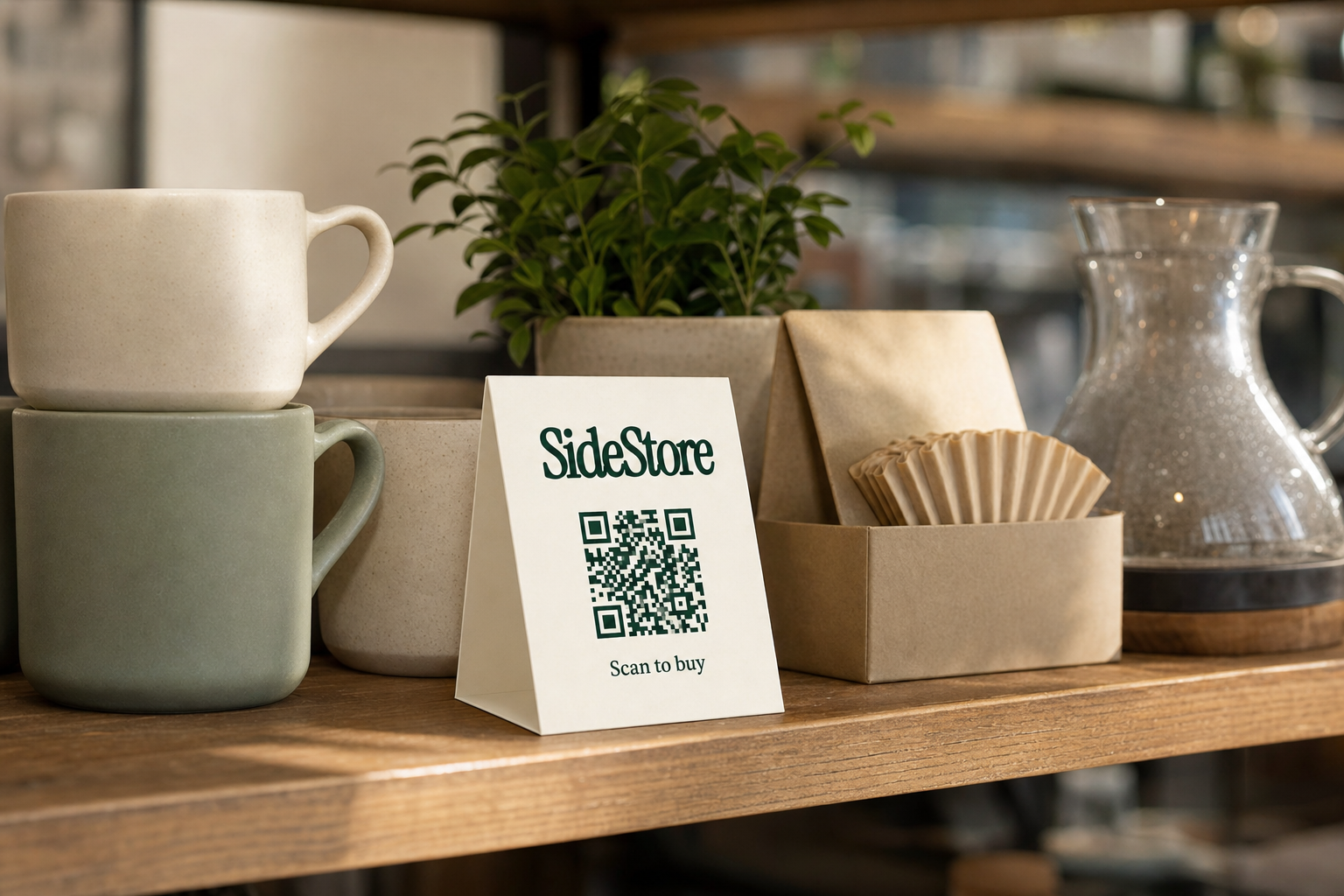
Products sell in cafés when they are placed where customers naturally pause, not where there is technically space on a shelf. The three locations that consistently convert are the till area, the collection point, and the entrance.
The till area captures customers at the point when they have already made a spending decision. They are primed to add something small. A product priced between ten and thirty dollars positioned within arm's reach of the payment moment is as close to a guaranteed browse as café retail gets.
The collection point captures dwell time. A customer waiting sixty to ninety seconds for their drink has nothing to do but look around. A small, well-lit display at eye level at the collection counter gives them something to pick up and consider.
The entrance captures curiosity on the way in and impulse on the way out. A display near the door catches customers who are relaxed after their visit and more receptive to a purchase than they were when they arrived.
Two display rules apply regardless of location. First, keep the display sparse. A shelf packed with products reads as clutter; five products arranged with space between them read as a curated selection. Second, ensure the QR scan-to-pay card, which is the checkout mechanism within the SideStore Retail Widget, is visible and unobscured next to the product. A customer who wants to buy but cannot easily see how to pay will not ask a barista.
Restock before a product drops below two units on display. A near-empty shelf signals slow sales and reduces the perceived desirability of what remains. Rotate the product selection every four to six weeks. Even customers who visit daily will engage with a display that changes. You can read more about how retail fits into community-oriented coffee shop models and how display choices affect average coffee shop profit across different operator types.
Frequently Asked Questions
The questions café owners most commonly ask before adding retail cover four practical concerns: the technology required, the financial split, what happens to unsold stock, and how large a product range to start with. Direct answers to each follow.
Do I need a separate POS to sell retail in a coffee shop?
No. SideStore's Retail Widget handles retail checkout independently of your existing till system. A customer scans the QR card attached to or displayed near the product, pays on their phone, and the transaction completes. You do not need to integrate with your existing POS or train staff on a new system.
What percentage does a coffee shop keep on consignment sales?
The host percentage in a consignment arrangement is negotiated directly between the café and the maker. A common range is twenty to forty percent to the host café, with the remainder going to the maker. The exact split reflects the product's margin, the café's foot traffic, and the display space provided. SideStore's Retail Widget processes the agreed split automatically on each sale, so no manual calculation is needed after the initial setup.
What happens to unsold consignment products in a café?
Unsold products are returned to the maker. The café owes nothing for stock that does not sell. This is the core structural advantage of consignment over bought inventory: your financial exposure on any given product is zero. Set a review period of four to six weeks in your written agreement so both parties know when a collection decision will be made.
How many products should a coffee shop sell in its retail section?
Start with one maker and between five and twelve distinct products. That is enough to create a credible display without overwhelming your available shelf space or your team's capacity to manage it. You can find related perspectives in the guides on alternatives to weekend markets for local makers and boutique inventory management, both of which address scale decisions from a practical operator standpoint.
Start With One Shelf
The practical next step is straightforward: start with one shelf, one maker, and one consignment placement. You do not need to redesign your café, hire a retail buyer, or commit capital to inventory. The SideStore Retail Widget handles the checkout, the stock tracking, and the split payout from the moment your first product goes live.
Consignment means your downside is a small amount of shelf space for a few weeks. Your upside is a passive revenue stream that runs alongside your existing café operation without adding meaningful work. That is a reasonable trade by any measure.
If you want to think through how to build a product offer with no inventory or revisit the mechanics of how consignment selling works, both articles give practical grounding before you approach your first maker.
When you are ready, SideStore is the place to set it up.